I know what keeps you up at night.
It’s not your product or your team. It’s the money. Whether you’ll have enough next month. Whether you can make payroll. Whether one slow week will tank everything you’ve built.
Financial stress isn’t just uncomfortable. It clouds every decision you make.
Here’s what I’m going to show you: how to turn your finances from a constant worry into something that actually works for you. No complex theory. Just the steps that matter.
You’ll learn how to manage cash flow without a finance degree. How to control expenses without cutting everything that makes your business run. How to build something that doesn’t fall apart when things get tight.
This comes from financial tips gscbizness, where we focus on what actually works when you’re running a business in the real world.
By the time you finish this guide, you’ll have a clear system. One that turns financial management from your biggest source of stress into something that gives you an edge.
Let’s get started.
Master Your Cash Flow: The True Lifeblood of Your Business
I’ll never forget what my accountant told me during my first year in business.
“You can be profitable on paper and still go bankrupt.”
I thought he was messing with me. How does that even make sense?
Then I watched it happen to someone I knew. They had contracts worth six figures. Clients loved them. But they couldn’t make payroll because everyone paid Net 60 and their expenses hit every two weeks.
Some people will tell you that profit is all that matters. They’ll say if you’re making money on each deal, you’re fine. Just keep doing what you’re doing.
But that’s not how businesses actually die.
They die when they can’t pay rent on Tuesday even though they’re owed $50,000 that won’t arrive until next month.
Here’s what I learned the hard way. Cash flow isn’t just another metric to track. It’s the thing that determines whether you can operate tomorrow.
Start with a 13-week cash flow forecast. I know that sounds boring. But it’s just a spreadsheet showing what money comes in and what goes out over the next quarter. Think of it as your radar for spotting problems before they hit.
You’ll see the gaps coming. That week where expenses are $8,000 but only $2,000 is coming in? You need to know about that now, not when your card gets declined.
Next, get paid faster. I started invoicing the same day I finished work. Not next week. That day. Then I added a 2% discount for anyone who paid within 10 days.
You’d be surprised how many people take that deal. And the ones who don’t? I set up automated reminders through my accounting software so I’m not chasing people manually.
Finally, flip the script on your payables. While you’re trying to collect faster, ask your suppliers for longer terms. Net 45 or Net 60 instead of Net 30.
That extra time keeps cash in your account longer. It gives you room to breathe when things get tight.
I picked up most of these gscbizness financial tips from craigscottcapital after nearly running out of cash twice in my second year. Now I check my forecast every Monday morning.
It’s not glamorous. But it works.
A Practical Budgeting Framework That Actually Works
Most budgets fail within the first month.
You track expenses for a few weeks. Maybe you build a nice spreadsheet. Then life happens and the whole thing falls apart.
I’ve seen this play out dozens of times. Business owners tell me they know budgeting matters, but their current system feels like busywork that doesn’t change anything.
Here’s what I recommend instead.
Flip the formula. Instead of Sales minus Expenses equals Profit, try Sales minus Profit equals Expenses. It sounds simple (maybe too simple), but it works.
Pay yourself first. Transfer a set percentage of every dollar that comes in straight to a separate profit account. Now you’re forced to run your business on what’s left.
This is the Profit First methodology. And yes, it feels uncomfortable at first. You’ll wonder how you’ll cover everything with less money available.
But that discomfort? That’s the point. It makes you question every expense in a way traditional budgeting never does.
Here’s a practical move you can make today. Run a monthly subscription audit. Pull up your bank statements and highlight every recurring charge. Software, services, memberships, all of it.
Ask yourself one question for each: If this wasn’t on auto-renew, would I buy it again today?
(You’d be surprised how many tools you’re paying for that you haven’t opened in months.)
Cancel anything that isn’t directly tied to revenue generation or core operations. I’m talking about the project management tool you bought but never fully adopted. The premium analytics platform when the free version does everything you need.
Now organize what’s left into three buckets. Fixed expenses like rent and insurance. Variable costs like materials and shipping. Growth spending like marketing and development.
This breakdown shows you exactly where your money goes. More importantly, it shows you where you can cut back without hurting the business.
When cash gets tight, you know variable costs are the first place to look. When you have extra, you can confidently put it toward growth because your fixed expenses are covered.
For more financial tips gscbizness owners can use, this framework gives you control without the complexity.
Pro tip: Set up separate bank accounts for each bucket. Physical separation makes it harder to accidentally spend profit money on expenses.
The goal isn’t perfection. It’s building a system that keeps working even when you’re too busy to micromanage every transaction.
Build Your Financial Fortress: The Business Emergency Fund

You don’t want to hear this.
But most businesses fail because they run out of cash. Not because their idea was bad or their product didn’t work.
They just couldn’t survive the gap between income and expenses when things went sideways.
I’ve watched it happen too many times. A client disappears overnight. Equipment breaks down. The economy hiccups. And suddenly you’re scrambling to make payroll.
Here’s what some people will tell you: just keep your money working. Put everything into growth. An emergency fund is dead money sitting there doing nothing.
And look, I understand that thinking. When you’re building something, every dollar feels like it should be pushing you forward.
But that’s exactly how you end up in trouble.
An emergency fund isn’t an investment. It’s insurance against the unexpected. It’s what keeps you in business when everything else falls apart.
The target is simple. Save 3 to 6 months of your essential operating expenses. I’m talking about payroll, rent, utilities. The costs you absolutely must cover to keep the lights on. You don’t need to account for every variable expense (that would take forever).
Here’s how you start. Open a separate high-yield business savings account. Not your main account where you’re constantly moving money around. A different one.
Then set up an automatic transfer. Take 1 to 5% of every deposit or invoice payment and move it straight into that account. The percentage doesn’t matter as much as the consistency. Start with what you can actually sustain.
I know 1% sounds tiny. But it adds up faster than you think.
Where should you keep it? The money needs to be liquid. You need to access it quickly when an emergency hits. But not so accessible that you’re tempted to use it for regular expenses or “opportunities” that pop up.
A separate savings account works perfectly. It’s there when you need it but requires a deliberate action to touch.
Some financial tips at gscbizness emphasize automation for a reason. When the transfer happens automatically, you stop thinking about it. The fund just grows in the background while you focus on running your business.
The hardest part is defining what counts as an emergency. Spoiler: a new marketing opportunity isn’t an emergency. A broken HVAC system in July? That’s an emergency.
Start building this today. Not next month. Not after your next big sale.
Today.
The 3 Financial Metrics You Absolutely Must Track
You don’t need a finance degree to know if your business is healthy or headed for trouble.
I’m going to show you three numbers that matter more than anything else on your balance sheet.
Some people will tell you to track everything. Revenue growth, customer acquisition cost, lifetime value, conversion rates. The whole nine yards.
But here’s what happens when you try to monitor 15 different metrics. You end up watching none of them well.
I’ve seen business owners drown in spreadsheets while missing the obvious warning signs right in front of them.
The Three Numbers That Actually Matter
Gross Profit Margin is your first line of defense. Take your revenue, subtract your cost of goods sold, then divide by revenue. This tells you if your core business model works before you even think about overhead. When this number drops, you’ve got problems that no amount of cost cutting will fix.
Cash Runway is simpler than it sounds. Divide your total cash by your monthly burn rate. That’s how many months you can survive if income stopped tomorrow. (And yes, you should know this number off the top of your head.)
Days Sales Outstanding shows you how fast customers actually pay. Take your accounts receivable, divide by total credit sales, then multiply by the number of days in the period. A high DSO means your money is stuck in unpaid invoices instead of your bank account.
Here’s what tracking these three metrics gets you. You’ll spot cash flow problems before they become emergencies. You’ll know if your pricing actually works. And you’ll see exactly where your money goes.
This is good financial advice for young adults gscbizness owners need to hear early. Not after they’ve already run out of runway.
Pro tip: Check these numbers weekly, not monthly. By the time your monthly report comes in, you’ve already lost three weeks to fix any problems.
The beauty of financial tips gscbizness owners can actually use? They’re dead simple to calculate and impossible to misinterpret.
Taking Control of Your Financial Future
You came here feeling overwhelmed by the numbers.
I get it. Running a business means juggling a thousand things at once, and the financial side can feel like a foreign language.
But here’s the truth: you don’t need an accounting degree to get this right.
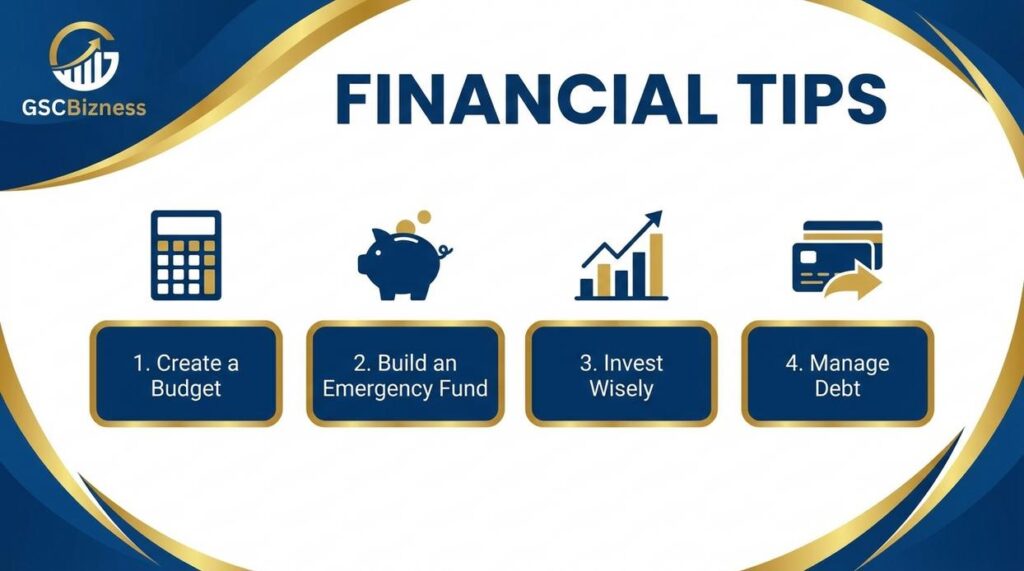
We’ve covered the practical steps that actually work. Cash flow management. Budgeting with a purpose. Building a safety net that lets you sleep at night. Tracking metrics that matter.
These aren’t theoretical concepts. They’re tools you can use starting today.
The overwhelm you’re feeling right now? It’s solvable. Thousands of entrepreneurs have been exactly where you are, and they’ve made it through by taking one step at a time.
You now have the roadmap. The question is what you’ll do with it.
Pick one strategy from this guide. Just one. Maybe it’s starting your 13-week cash flow forecast or setting up your first emergency fund. Whatever speaks to you most.
Then implement it this week.
Not next month. Not when things slow down. This week.
Action beats perfect planning every single time. Start small, build momentum, and watch how quickly clarity replaces confusion.
Your financial future is waiting. Go claim it.
For more financial tips gscbizness strategies that work, keep learning and keep moving forward.
 Founder & Chief Executive Officer
Pynsera Quill is the visionary founder behind GSC Bizness, leading the platform with a passion for modern entrepreneurship and strategic growth. With a strong focus on enterprise development, startup culture, and market intelligence, she has built the brand into a trusted destination for practical business insights. Her leadership style blends analytical thinking with innovative problem-solving, helping readers better understand evolving business landscapes. Pynsera oversees editorial direction, partnerships, and long-term expansion strategies while ensuring the platform stays informative and accessible. Known for her forward-thinking mindset, she frequently researches emerging market trends and operational strategies. Her commitment to educating entrepreneurs and professionals continues to shape the voice and success of GSC Bizness.
Founder & Chief Executive Officer
Pynsera Quill is the visionary founder behind GSC Bizness, leading the platform with a passion for modern entrepreneurship and strategic growth. With a strong focus on enterprise development, startup culture, and market intelligence, she has built the brand into a trusted destination for practical business insights. Her leadership style blends analytical thinking with innovative problem-solving, helping readers better understand evolving business landscapes. Pynsera oversees editorial direction, partnerships, and long-term expansion strategies while ensuring the platform stays informative and accessible. Known for her forward-thinking mindset, she frequently researches emerging market trends and operational strategies. Her commitment to educating entrepreneurs and professionals continues to shape the voice and success of GSC Bizness.